Keltron
A management and point-of-sale system I designed, built and run on my own. 4 clients use it in 5 locations, since August 2025.
- More than 21,000 orders processed
- 5 locations, 4 clients
- Restaurants, retail and kiosks
- Version 2.8, with changelog
Where it came from
The first client was a restaurant that needed to take orders, send them to the kitchen and close the register in one system. Today a retail store and a self-service kiosk use it too, and the challenge was making one product serve very different businesses without turning into three systems.
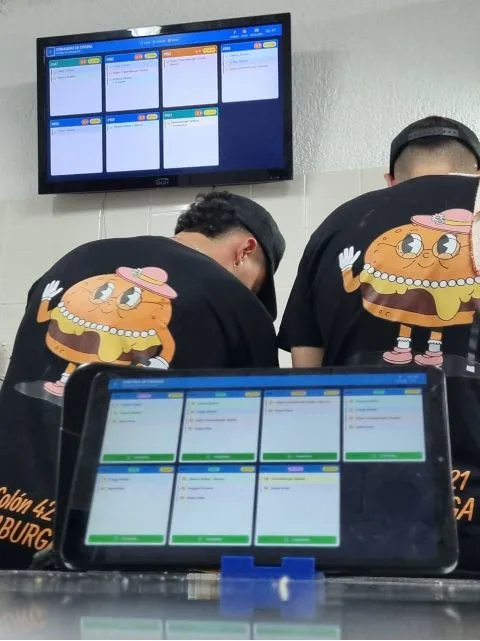
The screens
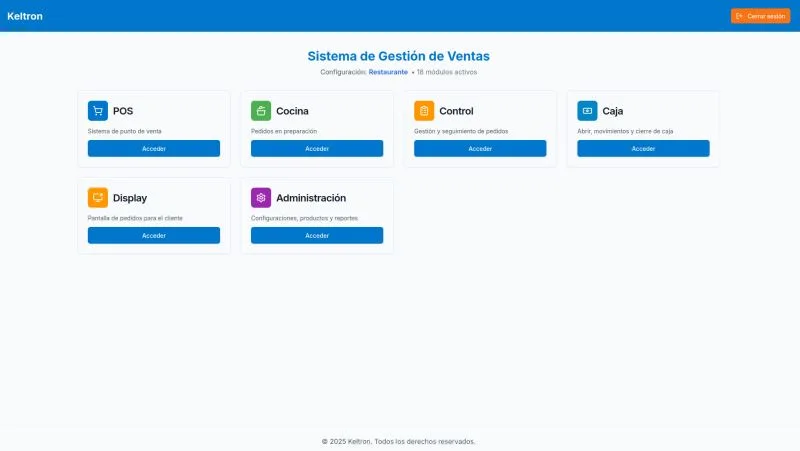
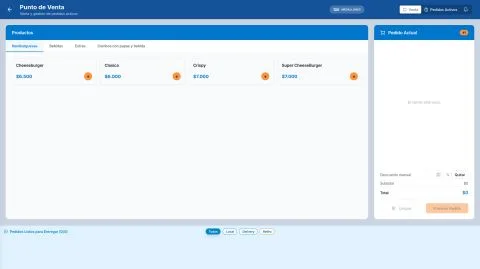

The stations on this line
The parts of the system and what each one is built with.
Core
Node.js · Express · Prisma · PostgreSQL · Swagger · Jest
Catalog, orders, stock, purchases, cash, customer accounts and reports. 90 data models and 124 test files.
Admin and point of sale
Next.js · React · TypeScript · Tailwind CSS · shadcn/ui
The cashier screen, the kitchen screen and the admin panel.
Real time
Socket.IO
An order taken at a table shows up instantly in the kitchen and at the register.
E-invoicing
Java 21 · Spring Boot
WSAA authentication with certificates and invoice issuing through WSFEv1 with AFIP / ARCA, Argentina's tax agency.
PDF
Node.js · Puppeteer
Invoices and reports generated from templates.
Printing
Node.js · ESC/POS
Receipts and kitchen tickets to thermal printers over USB or network, from the store itself.
Support assistant
Gemini · tool use
Answers questions about the admin panel by querying the real system, not a fixed text.
Online app
Next.js · Tailwind CSS · shadcn/ui
Online ordering for restaurants: menu, combos, cart, checkout and order tracking.
Also: central license management and remote deployment of updates to each installation.
Decisions I made
One system, five business types
Restaurant, retail, kiosk, services and hybrid all run the same code. The 18 modules always exist in the database and each business only turns its own on or off. If a client changes business type, no data is lost.
Invoicing in a separate service
AFIP requires certificates and access tickets that expire, and sometimes it does not respond. I isolated all of that in a Java microservice that caches the access ticket and reports when AFIP is down, so the point of sale never stops because of an external service.
The server decides the price
For combos, the client only says what was chosen. Quantities and prices are calculated on the server from the real catalog, with tests that simulate each combination, so nobody can pay less by changing an order.
AI that looks at real data
The support assistant does not improvise: it uses tools that query the backend and answers with what is really loaded for that business.