Cuotum
A platform to collect recurring fees: gyms, clubs, rentals and memberships. I designed and built it on my own, and it has been in production since 2026.
- 54 members loaded
- Mercado Pago and Talo
- 103 test classes
- cuotum.app
The problem
A small club or gym collects fees by hand: it sends messages, waits for bank transfers and checks the bank to see who paid. Cuotum automates that.
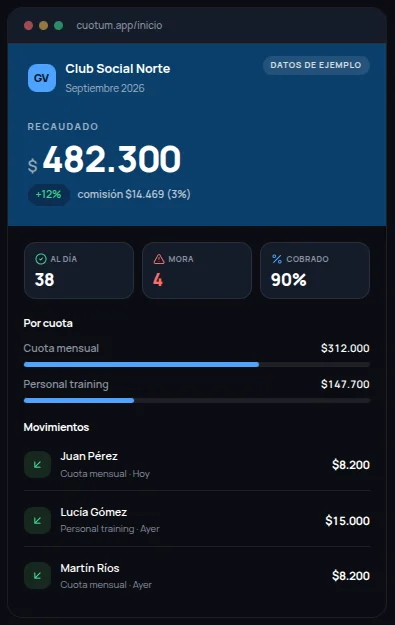
The business loads its members once. Each one gets a reminder with a link, pays from the phone, and the dashboard shows who is up to date and who is not.
The stations on this line
The parts of the platform and what each one is built with.
API
Java 21 · Spring Boot · Spring Security
Modular monolith with JWT, lockout after failed attempts and captcha. 431 classes, 103 of them tests.
Database
PostgreSQL · Row-Level Security · Flyway
Each business sees only its own data, isolated in the database itself. 57 versioned migrations.
Business dashboard
React 19 · Vite · TypeScript · Tailwind CSS · TanStack Query
Fee types, members, late payers, metrics per fee and export of debtors.
Payment link
React
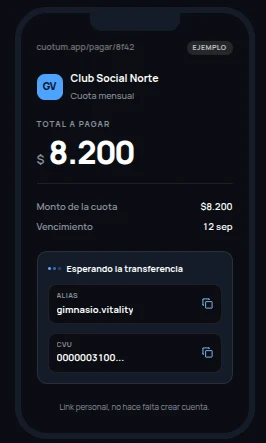
Members pay from the phone without creating an account. With their ID and a temporary code they can see all their fees.
Payment gateways
Mercado Pago · Talo
Each business chooses how to get paid. The payment is split instantly between the business and the platform.
Notifications
Spring Scheduler · WhatsApp · Email
Automatic due-date reminders, each one with its payment link.
What the member sees
The member installs nothing and creates no account. They open the link from WhatsApp or email, see how much they owe and when it is due, and pay.
If they pay late, the late fee is calculated at the moment of payment and shown broken down: fee, surcharge and total.
Decisions I made
Isolation does not depend on the frontend
The business for each request always comes from the token, never from what the browser sends. And in case something fails in the application, the database applies Row-Level Security: a badly built query cannot return another business's data.
Money is calculated in one place
Amounts in BigDecimal and NUMERIC, never floating point. The frontend does no math: it receives amounts already calculated and formatted, so there are never two versions of the same total.
Money does not go through the platform
With split payments, each payment is divided on the spot: the fee goes straight to the business and only the commission reaches Cuotum. It keeps taxes simpler and the business gets paid without waiting.
It will not start with unsafe settings
In production, the backend refuses to start if the token signing key or the allowed origins still have development values. A configuration mistake shows up at deploy time, not later.